Before You Accept a Second-Hand Child Car Seat
Three things you can ask for before pickup are the seat’s history, a photo of its label and its exact manual. Here’s how to use them.
A relative offers you the seat their child just outgrew. It would be handy in a grandparent’s car for school pickups in Caledon. Before arranging the handoff, ask whether they have owned the seat since new and whether it was ever in a vehicle during a collision. If they received it from someone else and cannot account for its earlier history, Health Canada advises against using it. That answer can save you a trip.
Ask about the seat, including trips when it was empty
“Was anyone hurt?” and “Was the seat occupied?” leave out an important detail. The question Health Canada asks is whether the seat was **in the vehicle during a collision**. Its guidance for people considering a second-hand seat is to choose one with a known, collision-free history. A clean cover, a smoothly clicking buckle or a picture of an intact shell cannot establish that history.
If the owner can account for the seat, ask for clear photos of the manufacturer's label and the Canadian National Safety Mark. Get a picture of the whole seat and any separate base offered with it. With those in hand, you can do much of the remaining homework before anyone loads it into a car.
Read the dates on the seat itself
Copy down the manufacturer, model number and date of manufacture. A family may remember buying a seat shortly before a child was born, but the purchase date and manufacturing date can differ. Similar-looking seats may also belong to different model series. Use the identifiers on the actual seat when looking up instructions.
Find the manufacturer’s expiry information on the seat or in its manual. If the date is unclear, give the manufacturer the model number and manufacturing date and ask when that specific seat expires. If a separate base comes with it, check its own markings and confirm compatibility and usable life with the manufacturer. A newer-looking cover tells you little about the age of either component.
The National Safety Mark identifies a seat certified to Canadian standards. This is especially worth checking on a seat brought across the border. A familiar brand name or a Canadian retailer’s listing for a similar product cannot establish which version someone is handing you.
Check whether a recall applies to this particular seat
Use the model information to search Transport Canada’s child-seat notices and the federal recalls database. Read the notice through to the affected model numbers and manufacturing dates. A result for the same brand can concern a different seat. Equally, an owner’s recollection that “there was a recall a few years ago” leaves open whether the remedy was completed on this one.
If there is a match, follow the notice and contact the manufacturer about the remedy and any restrictions on use. Keep any confirmation with the manual. If you go ahead with the seat, register your contact information with the manufacturer so future notices can reach the person actually using it.
Lay out the parts before putting the seat in the car
Get the instructions for the exact model from the manufacturer if the paper manual is missing. Use its illustrated parts list to identify what should be present for your intended mode of use. If a strap or pad looks unfamiliar, ask the manufacturer to identify it. An online photo of a similar seat can easily show a different configuration.
On a harnessed seat, check that the buckle latches and releases, that the harness adjusts, and that the chest clip closes and stays closed. Check the attachment hardware against the manual. Stop if a part is missing, damaged or behaving differently from the instructions. Ask the manufacturer whether an approved remedy exists before using the seat.
Check the fit in the vehicle that will carry the child
Take the child’s current height and weight to the seat manual. Check the limits for the intended direction and mode. Then open the vehicle manual to the child-restraint section for the exact seating position you plan to use. This matters for a seat that will live in a grandparent’s car even if it worked well in the parents’ vehicle. Follow both manuals for installation.
Keep vehicle-side problems separate when arranging help. For example, if the vehicle’s own seat belt buckle will not latch, record the seating position and describe the fault when you contact Albion Auto Service. Questions about the child seat’s history, parts or recall remedy belong with its manufacturer. You can find Albion’s vehicle service information here.
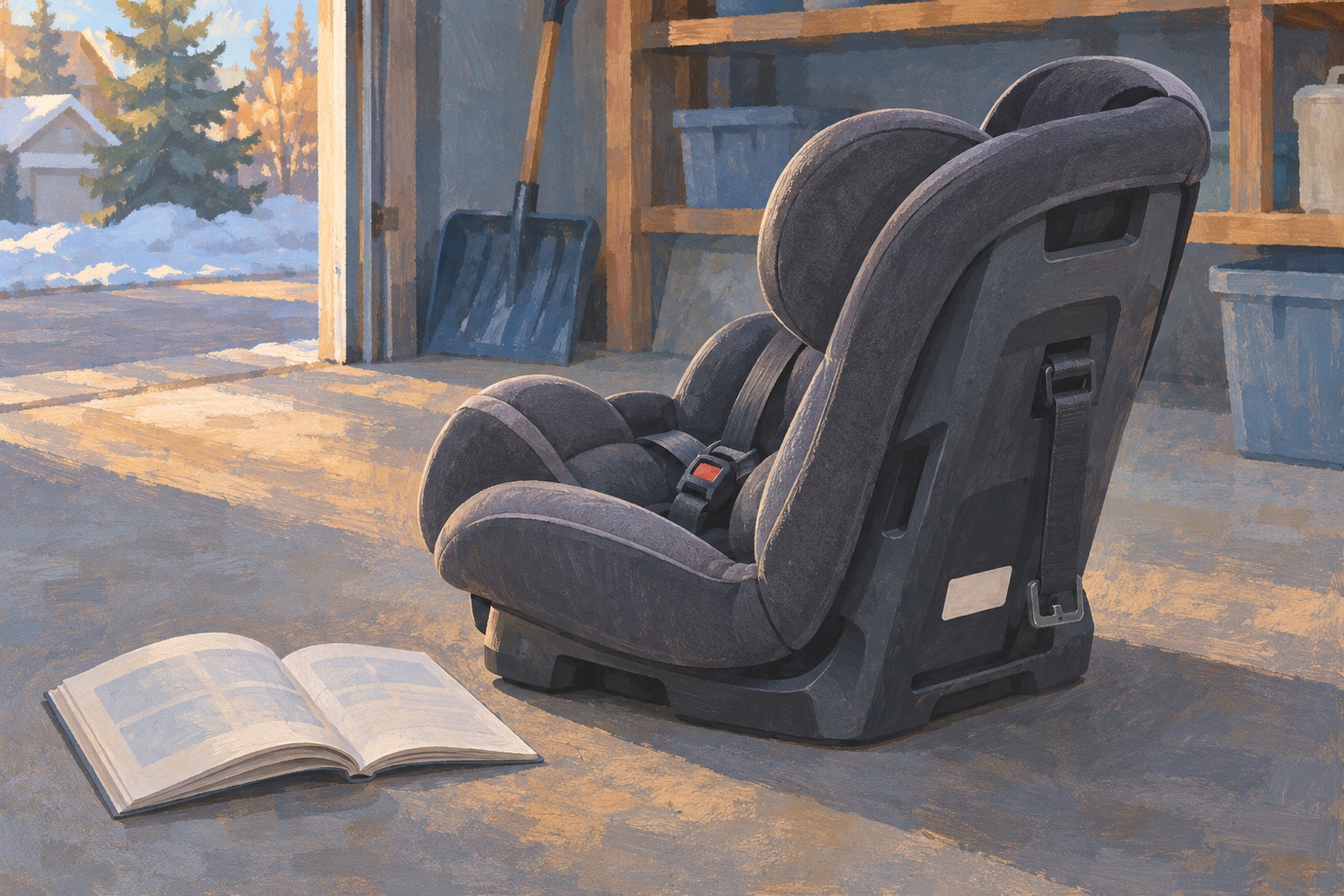
*Featured artwork is an AI-generated illustration.*
Common questions
Can I use a second-hand seat if its history is unknown?
Health Canada advises against it. This applies to a borrowed seat as well as a purchased one.
Can the original receipt tell me when a seat expires?
Use the model-specific information on the seat and in its manual. The manufacturer can help interpret the dates.
Where can I get a missing instruction manual?
Contact the manufacturer with the exact model number and manufacturing date. Use the matching instructions to check parts and installation requirements.
Sources and further reading
- Health Canada — Second-hand car seat and booster seat safety
- Transport Canada — Choosing a child car seat or booster seat
- Transport Canada — Expiry dates on child car seats and booster seats
- Transport Canada — Safety alerts and notices for child car seats
- Government of Canada — Recalls and safety alerts