Is Your Spare Tire Ready? Check Before You Need It
Confirm the equipment, pressure specification, condition and temporary-use restrictions before a flat tire interrupts your trip.
The spare tire is easy to forget until a flat makes it the most important item in the vehicle. Before winter, confirm what equipment your car actually carries, whether it is ready to use and what its limitations are. Finding an empty storage well or an unusable spare on a dark roadside is a problem you can often discover earlier, while safely parked at home.
For drivers in Bolton and Caledon, this check belongs alongside seasonal tire planning. It is not a recommendation to change a wheel beside moving traffic. Knowing the equipment helps you explain your situation when requesting assistance, even if you never intend to fit a spare yourself.
Start with the equipment your vehicle actually has
Read the owner's manual section covering a flat tire. Some vehicles carry a temporary spare, others a full-size spare, and some use another arrangement. Confirm what is installed rather than relying on the model name or assuming a previous owner left everything in place.
Locate the designated storage area and check accessible items without lifting the vehicle or crawling underneath it. If the spare is mounted underneath and access is difficult, ask the shop to include it in an inspection. Do not force a stuck carrier or improvise a way to release it.
If the manual describes a mobility kit, locate its instructions and identify its contents. Check any printed service or expiry information and ask about missing or used components. Having a compressor in the trunk does not establish that you have a complete kit or that it can address every kind of tire damage.
Check pressure using the correct specification
NHTSA includes the spare in its tire-pressure checks. Find the specification that applies to the spare fitted to your vehicle; do not automatically copy the pressure used in the four road tires. A temporary spare can have different requirements.
Use an appropriate gauge and follow the vehicle's cold-pressure instructions. If you cannot access the valve safely or cannot establish the correct specification, ask for assistance. Appearance alone cannot tell you whether an inflated spare is ready for service.
Write down the result and date so a later check has a useful reference. If the pressure repeatedly drops, ask for the cause to be investigated rather than merely adding air indefinitely. Explain how much was added and how long it took to drop again. The tire, valve and wheel need consideration before deciding what to replace.
Unused does not mean unaffected by age
A spare can have plenty of tread and still need professional attention. NHTSA notes that tires deteriorate over time and specifically discusses aging concerns for spare tires. Storage out of sight is not proof that a tire remains suitable indefinitely.
Look for accessible signs of cracking, cuts or other damage, and ask a tire professional to assess anything questionable. Do not treat a quick visual check as a substitute for an inspection when the history is unknown. If you cannot interpret the identification markings, ask the shop to explain them.
Keep any replacement record with the vehicle paperwork. When buying a used vehicle, include the spare in the questions you ask about tire history. “It has never been on the road” is useful information, but it does not answer every question about condition or suitability.
Read the temporary-use restrictions before an emergency
Michelin's guidance directs owners of temporary spares to check the applicable inflation, speed and distance limitations. Use the labels and owner's manual for your particular equipment. Do not apply a generic speed or distance number from another vehicle.
Also review any instructions about permitted wheel positions or vehicle operation. If something is unclear, ask before a flat occurs. The purpose of preparation is to understand the restrictions without having to interpret unfamiliar instructions under roadside pressure.
A spare is not a reason to postpone assessment of the damaged tire. Plan how the vehicle will reach suitable service within its equipment limitations. If the route, weather or vehicle condition makes that impractical, discuss transport instead of assuming the spare makes any journey acceptable.
Confirm the tools and access information
Check that the tools listed for the vehicle are present and stored as instructed. If locking wheel fasteners are fitted, locate their matching key. Make sure another regular driver knows where the equipment and manual are kept.
This is an inventory check, not an invitation to practise lifting the car without the proper procedure. Never place any part of your body beneath a vehicle supported only by its emergency jack. A roadside location, soft ground or nearby traffic can make a wheel change inappropriate even when the tools are complete.
If equipment is missing, identify the correct replacement for the vehicle. Do not assume a jack or wrench from a different car is suitable because it fits in the storage space. Confirm compatibility and the manufacturer's instructions rather than solving one missing-item problem with an uncertain substitute.
Restore the kit after it has been used
After a flat, make checking the spare and tools part of the follow-up. Confirm that everything returned to the vehicle is serviceable and secured in its intended position. Loose equipment in the cargo area should not become the permanent storage arrangement.
Tell the tire professional whether sealant was used, whether the tire was driven while low or flat, and what happened before the pressure loss. Those details help determine the appropriate inspection. Our article on punctured-tire repair decisions explains why repairability should be established from the tire's condition rather than guessed from the visible hole.
When arranging seasonal work, ask whether your spare and roadside equipment can be checked too. Review our tire service information or contact Albion Auto Service with the vehicle details and any concerns. A ready spare starts with correct identification and condition checks, followed by repairs or replacement where the findings justify them.
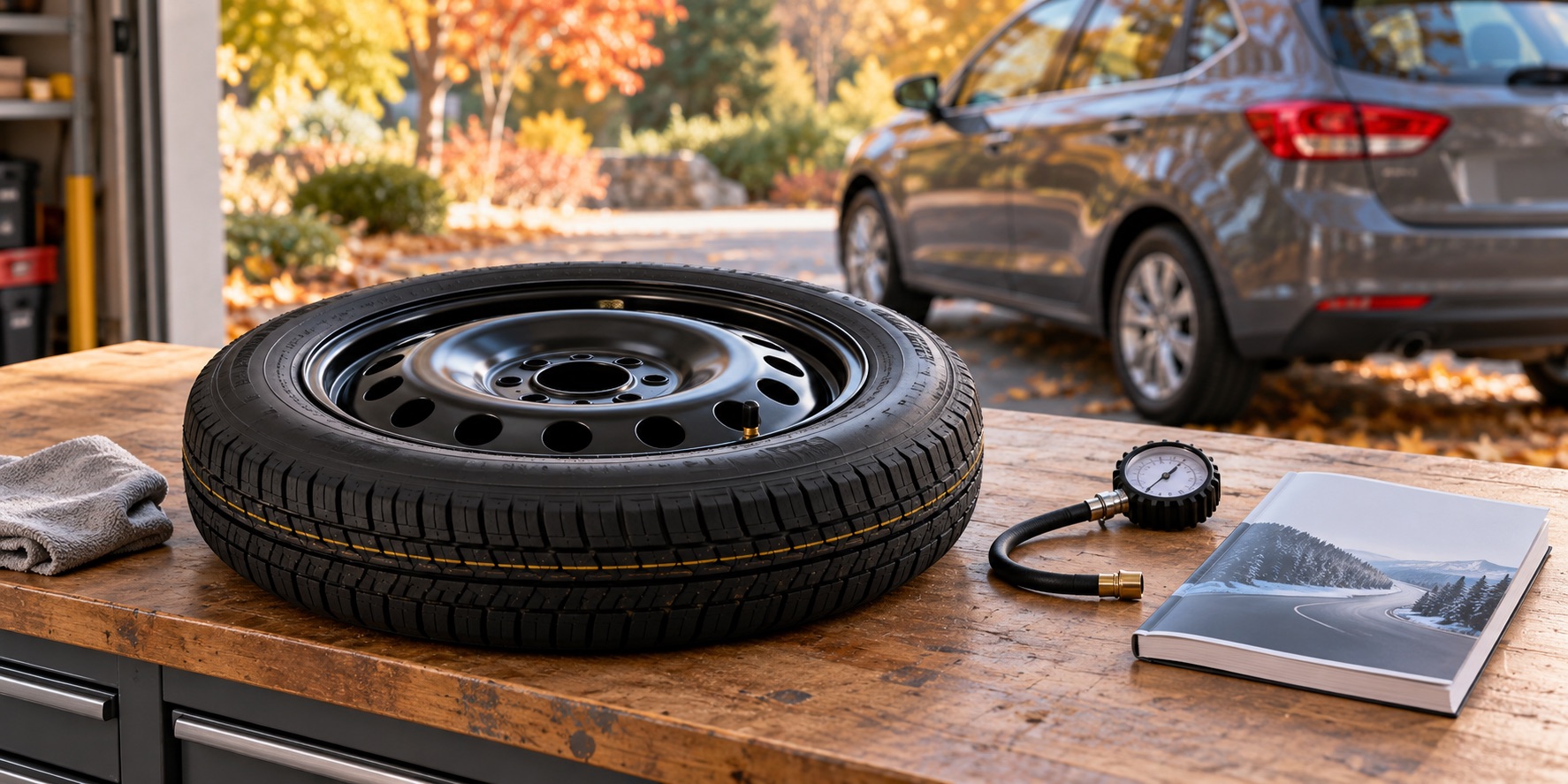
Featured image: AI-generated illustration of a generic spare wheel, gauge and handbook. It is not an Albion Auto shop or customer photograph and does not specify fitment, pressure or a wheel-changing procedure.
Common questions
Should the spare use the same pressure as the road tires?
Do not assume so. Find the specification for the spare fitted to your vehicle in the manual and applicable labels.
Can an unused spare need replacement?
Yes. Tires age even when they are rarely used. Ask a professional to assess condition and applicable replacement guidance.
Should I change a wheel beside traffic?
Do not attempt a wheel change where conditions are unsafe. Request roadside assistance and follow the vehicle instructions.