Brake Pads Getting Low? Ask What the Inspection Shows
Ask which pads were measured, whether wear is even and what supports any related repair before approving replacement.
“Your brake pads are getting low” should lead to a clear explanation, not a guessing game. Which pads were checked? What was measured? Is the wear reasonably even, and what condition are the related components in? Those details help you understand why replacement is recommended and whether something else needs attention.
For drivers in Bolton and Caledon, an inspection report is most useful when it separates measured wear, operating symptoms and the proposed repair. A pad replacement can be appropriate maintenance. Uneven or unexpectedly rapid wear, however, deserves an explanation before the same pattern affects new parts.
Ask what the measurement represents
Request the remaining friction-material thickness and the position of the pad being described. The metal backing plate is not usable friction material. A statement about the front brakes should make clear whether it represents the thinnest pad found, a range of readings or only the part visible during a preliminary check.
Ask which service limit or recommendation is being applied to your vehicle and brake components. Avoid treating a single number found online as a universal rule for every design and condition. The inspection should explain both the measurement and the reason for the recommended timing.
If the report uses a colour or percentage, ask for the underlying findings. Those summaries can help prioritize work, but they are easier to interpret when accompanied by actual measurements and observations. Keep the report so a later inspection can be compared with something more precise than “brakes looked okay.”
One visible pad does not describe the entire axle
Looking through a wheel may provide a useful preliminary view, but it does not necessarily show every pad or surface clearly. Ask whether the inspection assessed the inner and outer pads and both sides of the axle. A photograph of one accessible pad should not be mistaken for a complete record of all the brakes.
Wagner's brake-system inspection checklist discusses differences between inner and outer pad wear and the need to inspect related hardware and operation. The practical point for an owner is straightforward: the location and pattern of wear matter, not just the best-looking pad.
If access limited an initial check, ask what further inspection is needed. That is a useful distinction between a preliminary observation and a confirmed recommendation. It also helps explain why an assessment may change once the brakes can be examined more completely.
Uneven wear is a reason to investigate
When one pad has worn much more than its partner, ask what the technician found that could explain the difference. Wagner identifies possible concerns involving caliper movement, pad movement in the bracket, the piston and the brake hose. These are possible causes to assess, not a shopping list of parts that must all be replaced.
A sensible explanation connects the observed wear to a confirmed condition. Ask whether movement or operation was checked and what supports any recommendation for a caliper or other component. If more testing is required, the shop should be able to explain the question it is trying to answer.
Avoid choosing a replacement component based only on a photograph from another vehicle. Similar-looking wear can appear in different circumstances. Your vehicle's configuration, service history and inspection findings should guide the work. New pads alone cannot be assumed to resolve an unconfirmed underlying problem.
Include the rotors in the discussion
Pad thickness is only part of a disc-brake assessment. Ask what was found on the rotors and whether the relevant measurements were compared with the correct limits. A rotor that looks substantial at its outer edge still needs an appropriate assessment of its working surfaces and thickness.
Brembo's minimum disc-thickness guidance emphasizes checking disc thickness during maintenance rather than concentrating only on the pads. Use the component-specific limit and the inspection findings; do not substitute a generic minimum value from a different application.
If rotor work is recommended, ask what supports it: a measurement, surface condition or another verified finding. If reuse is proposed, ask how suitability was assessed. Neither an automatic promise to reuse every rotor nor a vague statement that every rotor is bad gives you the evidence needed to understand your own repair.
Bring symptoms and service history into the assessment
Tell the shop about any grinding, pulling, vibration, warning message or change in pedal feel. State when it happens and whether it began before or after recent work. Do not deliberately reproduce a braking problem to make a recording. Observations from ordinary use are enough to begin the conversation.
Bring the previous brake invoice or inspection report if available. It can identify what was replaced, which axle was serviced and what findings were recorded. If you bought the vehicle recently and do not know the history, say so rather than estimating when the brakes were last done.
Do not wait for a planned pad check if braking performance has changed significantly or the vehicle gives a stop-driving warning. Stop safely and arrange assistance when braking is in doubt. A maintenance estimate is not a substitute for responding to a current safety concern.
Leave with a clear repair and follow-up record
Before authorizing work, ask which items address ordinary wear and which address a diagnosed operating problem. Request an explanation of what will be checked after repair. If the recommendation is to monitor the pads, ask when they should be rechecked and what symptoms require earlier attention. A remaining thickness reading alone cannot promise an exact number of kilometres.
Read our brake service information or contact Albion Auto Service with the vehicle details, symptoms and previous records. The goal is a recommendation you can understand: what is worn, what caused any abnormal pattern and what evidence supports the work before parts are selected.
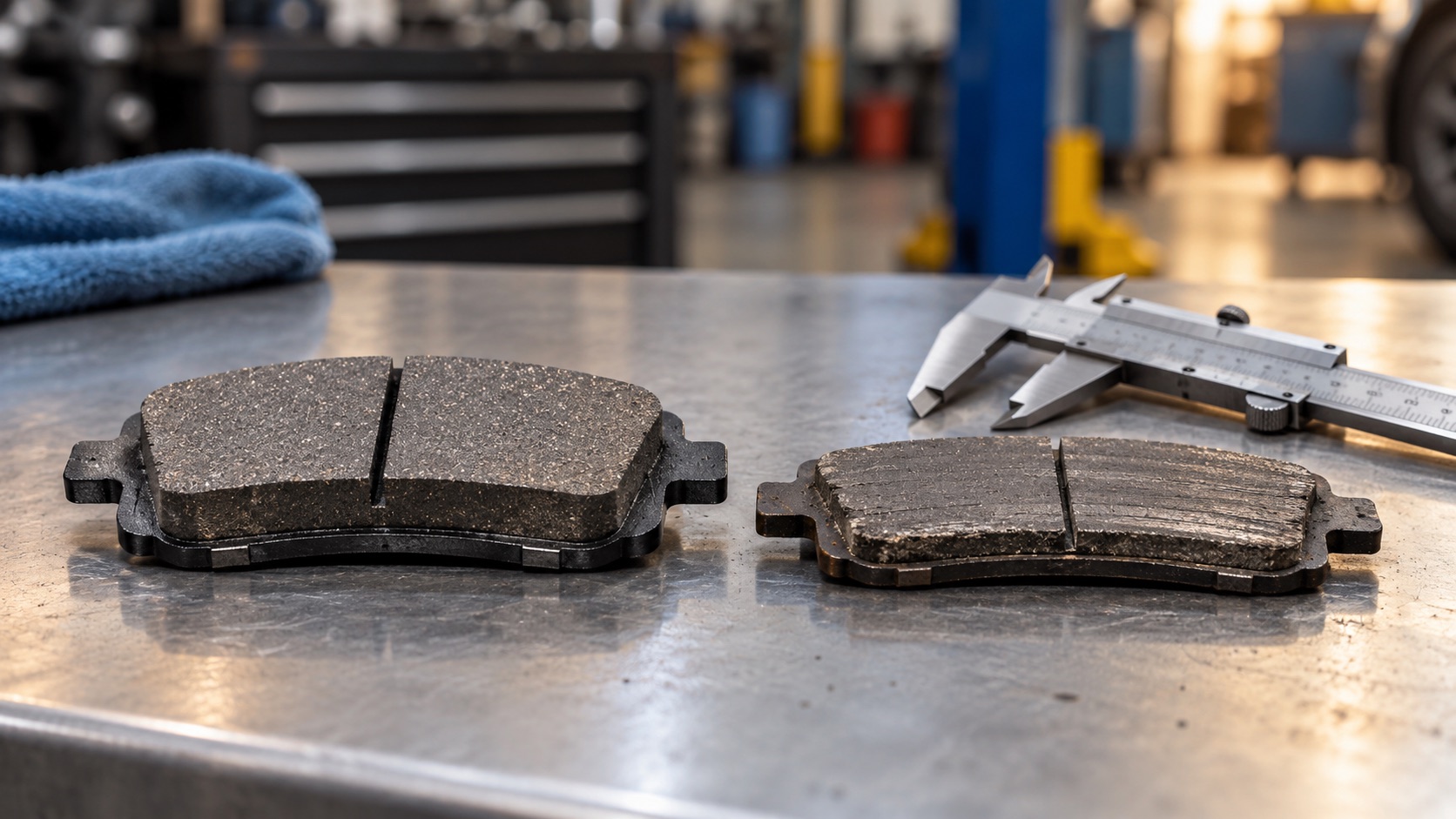
Featured image: AI-generated illustration comparing generic brake pads on a workbench. It is not a real inspection result, a wear-limit chart or an Albion Auto shop or customer photograph.
Common questions
Does one visible pad show the condition of all the brakes?
No. Ask whether inner and outer pads and both sides of the axle were assessed, and whether access limited the initial check.
Does uneven pad wear automatically mean a new caliper is needed?
No. Ask what operational checks and findings support the proposed repair. The wear pattern is a reason to investigate.
Can remaining pad thickness predict exact kilometres left?
No. Ask for the applicable recommendation, recheck timing and symptoms that require earlier attention.