Why a Check Engine Light Scan Is Not a Diagnosis
A scan identifies what the vehicle detected. Testing establishes why it happened and which repair is justified.
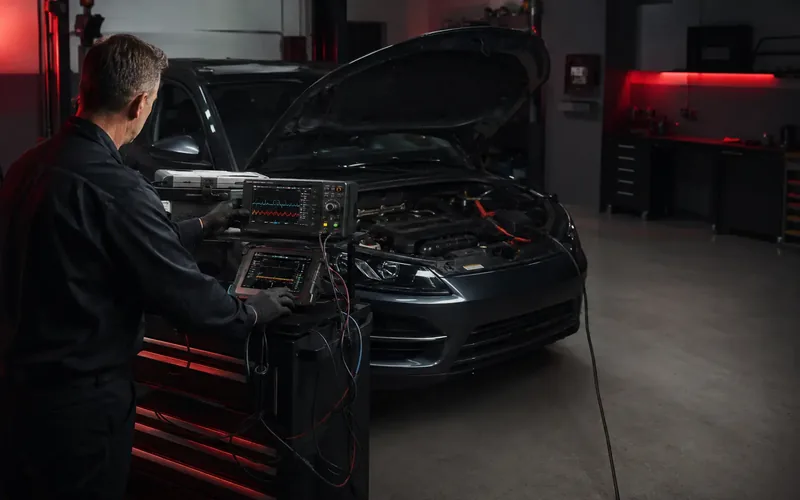
A check engine light scan and a diagnosis answer different questions. A scan tells us what the vehicle's computers have detected. Diagnosis establishes why the fault occurred and what work is needed to correct it. Replacing a component simply because its name appears in a code description skips the part that matters most.
That distinction affects both the repair bill and the chance of a lasting result. A sensor may report a problem accurately while something elsewhere causes the abnormal reading. The useful next step is to gather evidence that separates those possibilities, rather than turning a trouble code into a shopping list.
What a scan actually provides
Depending on the vehicle and equipment, a scan can retrieve trouble codes, module identification, operating data and a snapshot of conditions when a fault was recorded. A full-system scan may also reveal related faults in other modules. These records help build a picture, but they do not automatically establish the failed part.
The exact code definition and test procedure must match the vehicle and control system. A generic description on a phone app may omit manufacturer-specific detail. The same warning lamp can accompany very different conditions, so the repair should follow the evidence from the particular vehicle.
Why a component name can be misleading
An electrical circuit includes more than the component connected to it. It can include a power supply, ground path, connectors, wiring and a control module. An abnormal signal might come from a failed sensor, but it could also result from a poor connection or a genuine mechanical condition that the sensor is detecting.
Similarly, a mixture-related fault does not establish that an oxygen sensor is defective. The diagnostic task is to determine whether the reading is plausible, whether the engine is actually operating outside the expected range, and what could create that condition. Testing narrows the possibilities before parts are ordered.
These are general diagnostic relationships, not descriptions of a particular customer's repair. A specific conclusion requires the vehicle's test results.
Your description helps direct the testing
An intermittent concern can be difficult to reproduce in a service bay. Details about the conditions often save more time than a guess about the component. Tell the shop when the warning appeared and whether the vehicle behaved differently at the same time.
- Did it happen during a cold start, highway driving or acceleration?
- Was the engine fully warm?
- Did the problem follow refuelling, a battery replacement or other work?
- Was there hesitation, rough running, reduced power or an unusual noise?
- Has the light gone out and returned?
If you already have a scan report, keep it. Avoid clearing codes before the appointment unless the technician asks you to. Clearing can remove useful fault information and reset diagnostic monitors without correcting the underlying cause.
A sensible diagnostic sequence
The first step is to confirm the complaint and identify the vehicle accurately, including its engine and relevant equipment. The technician then reviews fault records and looks for related information. A visual inspection can uncover disconnected hoses, obvious wiring damage, loose terminals or evidence of recent work before more involved testing begins.
Next comes a test plan. That plan may compare commanded and actual values, check a circuit under load, measure pressure or examine how a signal changes while the symptom occurs. Not every vehicle needs every test. The point is to choose measurements that distinguish the likely causes efficiently.
Service information matters here. Connector views, circuit operation, operating conditions and the manufacturer's diagnostic sequence keep testing tied to the actual system. Where a current bulletin is relevant, its applicability must be checked against the vehicle rather than assumed from a similar symptom online.
Why an intermittent fault may take longer
A fault that happens once on a damp morning may not be present when the vehicle arrives. The stored information can guide the next step, but a normal reading in the bay does not prove the problem has disappeared. Some concerns require a controlled road test or recording data over time.
In Southern Ontario, moisture and corrosion can be relevant to electrical inspection. That does not make every intermittent problem a corroded connector. The inspection still needs to establish a connection between the observed condition and the fault. A photograph of corrosion is useful evidence only when its effect on the system is understood.
If the symptom cannot be duplicated, the report should say so plainly. “Further testing required” is more useful than a confident parts recommendation unsupported by results.
What you should receive from the diagnosis
A useful explanation connects the complaint, the test and the conclusion. It should tell you what was found, why that finding matters and what repair is proposed. If there are uncertainties, those should be identified before you authorize the next stage.
Ask what evidence supports replacing the recommended component. The answer might involve a failed measurement, a confirmed circuit defect or a mechanical finding. You do not need to interpret every scan parameter yourself, but you should be able to understand the reason for the recommendation.
Diagnostic work is a service even when the final repair is simple. Finding a damaged wire or a poor terminal connection can require careful testing, while the actual repair may involve very little material.
Verification closes the loop
After the repair, the technician should confirm that the relevant fault has been corrected using the appropriate checks. Simply erasing the warning light is not verification. Depending on the system, confirmation may involve repeating the original test, checking operation during a road test or allowing the relevant monitor to run.
A warning light does not support a universal “safe to drive” answer. If it accompanies severe rough running, overheating, abnormal noises or a substantial loss of power, stop using the vehicle and get advice about recovery. The owner's manual provides the vehicle-specific warning instructions.
For a warning light that needs investigation, check engine light diagnosis starts with what the vehicle is doing and follows the evidence. The aim is a justified repair, not a sequence of guesses.
Common questions
Can I clear the code before the appointment?
It is better to preserve the scan information unless the technician asks you to clear it. Clearing can remove useful evidence.