
Vibration at Idle? Ask What the Engine-Mount Inspection Shows
A shake at idle does not identify a failed mount by itself. Record the conditions and ask what inspection findings support the repair.
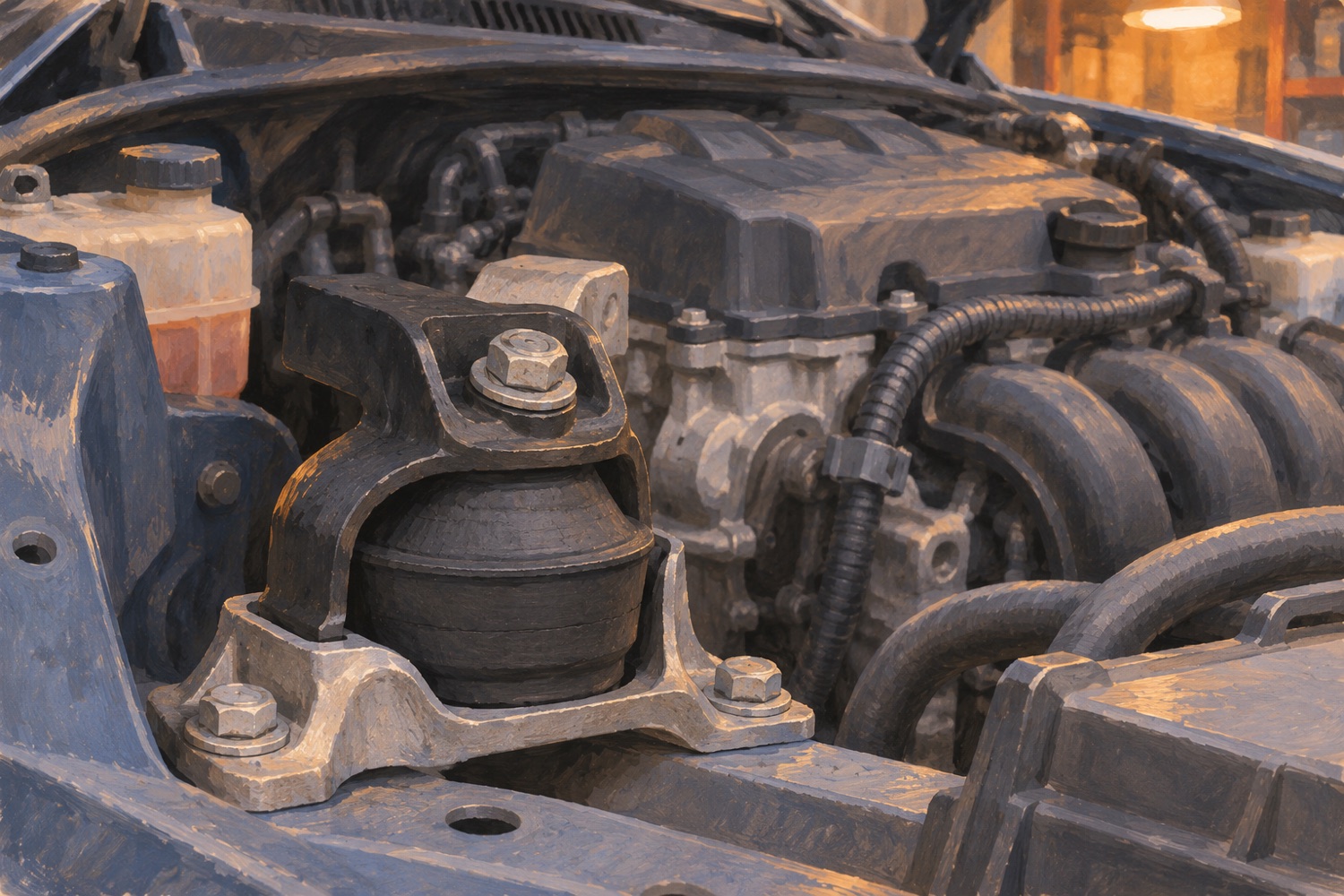
A new vibration through the seat or steering wheel while your car is stopped deserves a clear description before it gets a parts estimate. Engine and transmission mounts are one possible area to inspect, but the words “shakes at idle” do not identify a failed mount on their own.
For drivers in Bolton and Caledon, the most useful first step is to record when the change happens. Does it begin with a cold start, remain after the vehicle warms up, or appear only under particular operating conditions? That information helps an inspection address the complaint you actually have.
What mounts contribute to comfort
Engine and transmission mounts support the powertrain while limiting how much vibration reaches the vehicle body. Different vehicles use different designs. Some use rubber isolation, while others use fluid-filled or controlled mounts. The correct inspection depends on the installed system.
Mount manufacturer Anchor explains that deteriorated rubber and leaking hydraulic mounts can lose their ability to isolate vibration. Its guidance also notes that vibration associated with worn mounts can become more noticeable with the air-conditioning compressor engaged. These are reasons to inspect, not proof that any car with a noticeable idle needs new mounts.
Avoid buying a mount based only on a similar vehicle's online video. A similar sound or shake can be a useful comparison, but the diagnosis still belongs to your particular vehicle.
Separate a vibration from a description of engine running
Owners often use “rough idle” to describe several sensations. One person means the engine seems to stumble. Another means the engine sounds steady but the seat buzzes. A third notices an occasional knock as the vehicle begins moving. Tell the shop which description fits, or use your own words.
You do not need to identify the mechanical cause. Mention any warning light, unusual exhaust sound, loss of power or change in the displayed engine speed. A steady rev-counter needle does not by itself establish that the engine is running correctly, and the absence of a warning light does not settle the question either.
The inspection needs to consider both how the engine is running and how movement or vibration is being transmitted. Replacing an isolating component without understanding the vibration source can leave the original concern unresolved.
Record the conditions during ordinary use
A short note is more useful than a long list of suspected parts. Include these details if you already know them:
- Whether the vehicle was stationary or moving when the vibration occurred.
- Whether it happened immediately after starting or after a normal drive.
- Where you felt it most clearly: steering wheel, seat, floor or dashboard.
- Whether it was continuous, intermittent or accompanied by a clunk.
- Any warning messages or recent work that coincided with the change.
If you noticed a difference between normal operating conditions, include it. For example, explain that you felt the vibration while waiting at a light but not after parking. That observation gives the technician a condition to investigate; it does not establish a particular mount failure.
Do not deliberately repeat an uncomfortable or severe symptom to make the note more complete. A brief recording made safely while parked can sometimes help explain a noise, but it cannot replace an inspection. Never handle your phone while driving to capture it.
Mention recent work without assuming blame
If the vibration appeared after a repair, provide the date and the work order. Also say whether it was present beforehand but has become more noticeable. This helps the technician compare the timeline with the components and operating conditions involved.
Useful records might include previous mount replacement, engine or transmission work, or an exhaust repair. A timing connection is a reason to look carefully, not an automatic finding that the previous repair caused the problem.
If a mount was replaced previously, bring the part information if available. It may help identify what is fitted now. Avoid ordering another part simply because the first repair did not change the symptom; the next step should be to revisit the evidence.
Leave loaded tests to the technician
Some online demonstrations involve applying throttle against the brakes, watching an engine move while a gear is engaged, or lifting part of the powertrain with a jack. Those are not necessary owner checks. Do not try them in a driveway to decide whether to buy a mount.
Do not put hands or tools near a running engine's belts, fans or other moving components. Do not get under a vehicle supported only by a jack. An owner can provide a useful symptom history without opening up those risks.
If vibration becomes severe, is accompanied by a heavy new knock, or affects how the vehicle drives, stop in a safe place and seek advice about inspection or recovery. Follow the owner's manual for any warning light or message rather than assuming it is related to a mount.
Ask which finding supports replacement
A good estimate should identify the affected component and explain why replacement is proposed. Anchor's inspection guidance distinguishes findings such as rubber damage, hydraulic leakage or collapse, and concerns involving controlled mounts. That variety is another reason not to diagnose every vibration by appearance alone.
Ask what was found on your vehicle and how it relates to your complaint. If several mounts are recommended, ask about the condition of each one and the reason for the proposed scope. There is no useful universal answer that every mount must always be replaced together.
Also ask how the repair will be checked. Ideally, the follow-up compares the original symptom under the relevant conditions. If the concern could not be reproduced, agree on what additional information would help rather than treating an unconfirmed guess as a result.
You can review Albion Auto Service's service information or contact the shop with your vehicle's year, make, model and symptom notes. A clear history helps the conversation start with the cause and the evidence needed to confirm it.
Featured artwork is an AI-generated illustration of a generic engine compartment and mount, not a vehicle-specific service diagram.
Common questions
Does vibration at idle prove an engine mount is worn?
No. Mount condition is one part of the inspection. Engine operation and the conditions under which the vibration occurs also matter.
Should all engine mounts be replaced together?
Ask for the findings and reason for each proposed replacement. The appropriate scope depends on the vehicle and condition of its components.
Should I test engine movement against the brakes at home?
No. Leave loaded tests and powertrain support to the technician. Record symptoms from ordinary use instead.