
Battery Testing: Why Voltage Alone Is Not Enough
A plausible voltage reading cannot establish that a battery will start the vehicle reliably or explain why it keeps going flat.
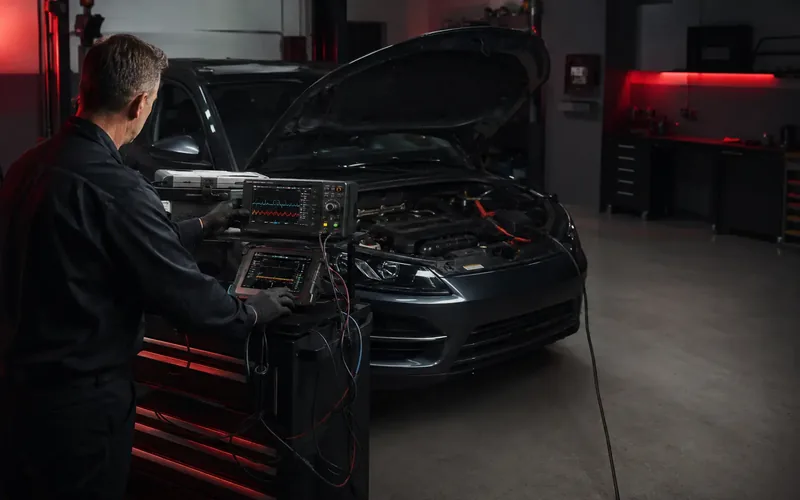
A battery can display a plausible voltage and still fail to start the vehicle reliably. Voltage is useful information, but it does not describe every aspect of battery condition. A meaningful assessment considers charge level, the battery's ability to support the required load and the condition of the surrounding starting and charging system.
That is why a reading from a multimeter should be treated as one part of the diagnosis. It can direct the next test, but it should not become an automatic pass or a replacement instruction without context.
Charge level and battery condition are different
State of charge describes how much charge is available at the time of testing. Battery condition concerns its ability to perform the job expected of it. A serviceable battery can be discharged, and a deteriorated battery can show an apparently reasonable voltage after charging.
Midtronics notes that recent charging, recent loads and surface charge can affect resting voltage interpretation. Its guidance also distinguishes a voltage reading from the broader testing needed to assess the battery. There is no benefit in comparing numbers without considering how and when they were obtained.
The battery technology matters as well. The test equipment and procedure should match the battery fitted to the vehicle. Selecting the wrong type or rating can undermine the usefulness of the result.
A discharged battery is a finding, not a complete cause
If the battery is low, the next question is why. Short trips, an extended period parked, a charging problem or an electrical load remaining active can all deserve investigation. The pattern of use helps narrow the possibilities.
Tell the shop whether the vehicle struggles every morning, only after several days parked or after a particular accessory has been used. Also mention any recent work, jump-starts or battery charging. Those details help distinguish an isolated discharge from a recurring system problem.
Replacing a battery may restore starting temporarily without resolving a drain or charging fault. If the underlying issue remains, the new battery can eventually become discharged as well.
Proper preparation improves the test
The battery should first be inspected for condition and suitability. The technician checks the relevant connections and follows the tester's instructions for connection points, battery type and rating. A poor connection at the tester can produce an unreliable result.
Temperature and state of charge may affect how a result should be interpreted. If the equipment calls for charging and retesting, that is part of reaching a useful conclusion. A “charge and retest” instruction should not be casually converted into either “good” or “replace.”
The aim is to obtain a result under the conditions required by the test method. Otherwise, the number or decision on the screen can look precise while answering the wrong question.
Starting performance includes the cables and starter
During starting, the battery is only one part of the circuit. Connections, cables, grounds and the starter itself influence what happens. A slow crank does not automatically establish a weak battery.
Testing under load can help identify a connection that appears acceptable when very little current is flowing. A voltage-drop test examines the loss across part of a working circuit. That is different from checking continuity with the circuit inactive.
The technician chooses the relevant measurements for the symptom and vehicle. The useful conclusion connects the reading with the complaint, rather than assuming that any starting concern belongs to the battery.
Charging voltage needs operating context
A single charging-voltage reading does not describe every modern charging system. Some vehicles vary charging behaviour according to operating conditions and control strategy. Assessment needs to consider what the system is being commanded to do and whether it is responding appropriately.
That does not mean an abnormal reading should be ignored. It means the expected behaviour must come from the relevant vehicle information, supported by measurements. A universal “it must always show this voltage” rule can create a false diagnosis.
A charging check may therefore involve more than placing a meter across the terminals at idle. The complaint, fault information and system design determine what additional checks are useful.
Repeated discharge may require a draw investigation
If the battery tests serviceable and becomes discharged while parked, the vehicle may need a parasitic-draw investigation. Modern modules do not necessarily enter their low-power state immediately after the ignition is switched off. Testing must account for the normal shutdown process.
Opening a door, using a key or disturbing a connection can wake systems and change the measurement. That is why an organized test procedure matters. An initial current reading may not represent the vehicle's normal parked state.
Aftermarket accessories and recent repairs are useful background information, but they should not be blamed without evidence. The investigation needs to identify the circuit or operation responsible and confirm that correcting it resolves the abnormal draw.
Ontario weather can reveal a marginal system
Cold-weather starting places different demands on the vehicle than a mild-weather start. A system that seems adequate during warmer conditions may become less reliable as winter approaches. Checking a developing concern before the coldest mornings is more practical than waiting for a no-start.
Vehicle use matters too. A car that spends much of its time on short trips may have a different charging pattern from one driven for long periods. Explain your normal use so the technician can interpret the concern in that context.
Do not assume the weather is the complete explanation for repeated failures. It may reveal a weakness that still needs to be identified.
Ask for the result and the next step
A useful battery report identifies what was tested and what the result supports. If replacement is recommended, ask whether charging, starting or drain concerns also need attention. If the battery is serviceable, ask what other evidence explains the symptom.
When replacement is appropriate, the correct specification and any vehicle-specific registration or reset requirements need to be checked. Not every vehicle uses the same procedure, and a universal instruction is not a substitute for its service information.
For a recurring no-start or discharge concern, electrical diagnosis can examine the complete system. The goal is reliable operation backed by testing, rather than judging the battery from voltage alone.
Common questions
Can a good battery become discharged?
Yes. Vehicle use, a charging concern or a continuing electrical load can discharge a serviceable battery. The cause needs to be assessed.