Electronic Parking-Brake Warning? Start With the Exact Message
A parking-brake warning is a starting point for diagnosis. Share the message, operating conditions and recent service history before replacing parts.
An electronic parking-brake warning does not, by itself, identify a failed motor or caliper. It tells you to pay attention to the system's condition and the vehicle's instructions. Before buying parts, establish exactly what the message says and whether the brake has applied or released as intended.
For drivers in Bolton and Caledon, the first priority is keeping the vehicle secure. If it will not release normally, do not try to overpower the brake with the accelerator. If you cannot confirm that the vehicle is safely secured or safe to move, arrange assistance and describe the concern before anyone attempts to transport it.
Record the complete message
A parking-brake indicator can communicate operating status as well as a fault. The wording, colour and whether the lamp stays on or flashes matter. Read the owner's manual for your exact vehicle instead of identifying the problem from a similar-looking symbol online.
Ford's published message guide distinguishes an applied brake, an incomplete application or release, and conditions requiring service. Those are different situations. A message asking the driver to follow a release procedure should not automatically be treated as proof that a component has failed, while a service warning should not be dismissed as a routine reminder.
When safely stationary, photograph the message or write it down exactly. Include other warning lamps that appeared at the same time. Tell the shop whether the message occurred at startup, while applying the brake or while trying to release it. A clear sequence is more helpful than simply reporting that the dashboard lit up.
Follow the operating procedure for that vehicle
Electronic parking brakes do not all have identical release conditions. Use the instructions supplied with the car, including any requirements involving the brake pedal, power mode or other controls. Do not assume the routine from another vehicle applies.
If the expected operation does not occur, stop and seek guidance rather than repeatedly cycling the switch. Ford's message guide includes an overheating condition associated with repeated applications. That is a reason to avoid unnecessary repeated attempts, not a reason to use another model's waiting period or reset sequence as a universal remedy.
Do not experiment with the switch while driving to see how the system reacts. Emergency-operation instructions are vehicle-specific and are not a troubleshooting exercise. This article concerns recording a symptom and arranging an appropriate assessment, not testing emergency braking on the road.
Include recent battery history
Tell the shop if the vehicle recently had a flat battery, a jump-start, a battery replacement or a battery disconnection. Include approximately when it happened and whether the parking-brake concern appeared before or afterward.
Honda's owner guidance notes that a dead 12-volt battery prevents parking-brake application or release on the vehicle described. Ford also asks owners to consider battery-disconnection or discharge history for certain messages. These examples show why electrical history belongs in the assessment; they do not prove that every parking-brake warning needs a new battery.
Avoid disconnecting the battery just to try to erase the message. Follow the vehicle's instructions and obtain advice if power supply is in question. A warning that disappears temporarily is not, on its own, evidence that the cause has been identified or that normal operation has been confirmed.
Mention recent brake work
Bring the invoice if the rear brakes or related components were serviced recently. Explain whether the concern began immediately afterward or only later. Timing can help direct an inspection without establishing blame or proving which part is responsible.
Some electronic parking-brake systems have a maintenance mode used during brake service. Ford's owner information identifies such a mode separately from normal operation. If the display mentions maintenance or service mode, report the exact wording rather than following a generic online sequence to change it.
Do not dismantle the actuator, force a caliper mechanism or apply power directly to a component as an owner-level check. The correct service procedure depends on the vehicle. Ask the shop to verify the applicable procedure and the completed work before selecting replacement parts.
Separate the parking concern from other brake symptoms
Describe any change in pedal feel, stopping behaviour, noise, smell or vehicle movement as a separate observation. Do not assume that all symptoms share one cause simply because they appeared around the same time.
If braking feels abnormal, a brake warning requires stopping according to the manual, or there is smoke or an immediate hazard, stop safely and arrange assistance. Do not continue a journey to see whether the message clears. When calling, explain both the parking-brake message and the other symptom so the urgency can be assessed.
If the vehicle is stationary with the brake apparently stuck on, tell the recovery operator before loading is attempted. The operator needs to know about the condition and follow the appropriate transport procedure. Do not ask someone to drag the vehicle or improvise a release based on another car's design.
Ask what supports the proposed repair
A useful explanation connects the recommendation to the observed failure. Ask whether the technician confirmed the original complaint and what checks support replacing a switch, actuator, wiring component or another part. A fault message is a starting point for that work, not a complete parts list.
If the concern is intermittent, provide the original wording and the circumstances even if everything appears normal at the appointment. Keep the history factual. Record what you observed during ordinary use without deliberately provoking a fault or repeatedly operating the system for a video.
After service, ask how application, release and the original warning were checked. Keep the inspection notes and invoice. If the message returns, report whether it is identical and what happened immediately before it appeared.
Review our brake service information or contact Albion Auto Service with the vehicle details and exact message. The aim is to establish the cause, choose the appropriate repair and verify operation before relying on the system again.
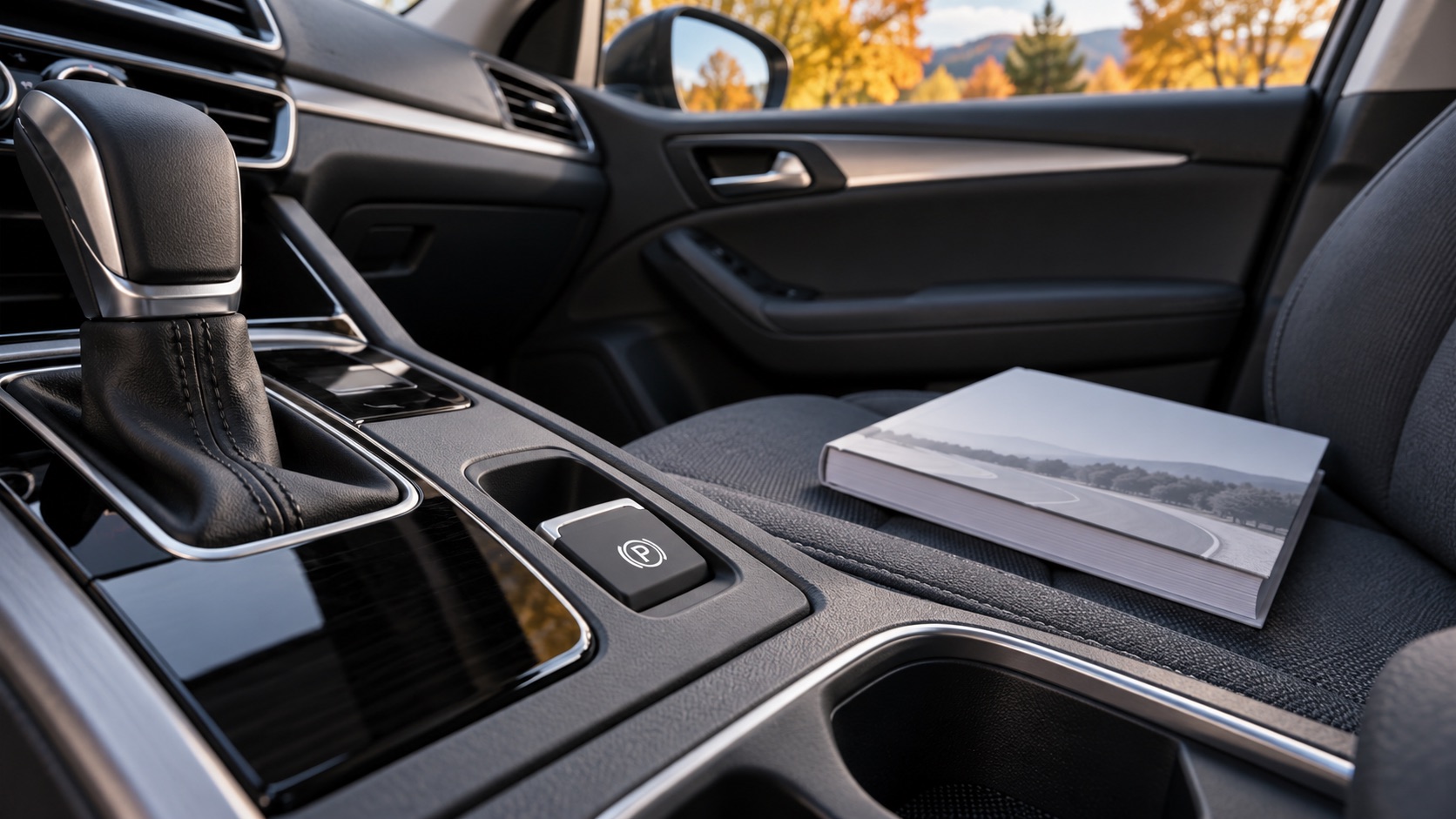
Featured image: AI-generated illustration of a generic parking-brake switch and handbook. It is not an Albion Auto shop or customer photograph and does not demonstrate a release, reset or repair procedure.
Common questions
Does the warning prove the parking-brake motor has failed?
No. Record the exact message and have the system assessed before selecting parts.
Should I accelerate to free a parking brake that will not release?
No. Do not try to overpower it. Follow the vehicle instructions and arrange assistance if it will not release normally.
Is recent battery work relevant?
Yes. Report discharge, jump-starts, replacement or disconnection, but do not assume the battery is the cause without checks.