How Road Salt Affects Brakes and Suspension
The location and extent of corrosion matter more than appearance alone. A useful inspection connects visible damage with function.
Road salt helps manage winter road conditions, but salt-contaminated moisture is hard on a vehicle's underside. Brakes, fasteners, steel lines and suspension structures can develop corrosion that affects serviceability or, in more advanced cases, their ability to do their job. What matters during an inspection is the location and extent of the damage, not simply whether rust is visible.
For vehicles driven through Bolton and Southern Ontario winters, corrosion deserves regular attention. It does not justify replacing every rusty-looking component. A useful assessment distinguishes surface appearance from restricted movement, weakened material, leakage and other functional problems.
Surface rust and structural damage are different
A light coating of surface rust on a steel part is not the same as deep pitting, heavy scaling or loss of material. The significance also depends on the component. A cosmetic mark on a bracket and deterioration of a brake line cannot be judged in the same way.
The technician needs to inspect the affected area and explain what makes it serviceable, in need of monitoring or due for repair. In some cases, access is limited until covers or other components are removed. A clear report should identify those limitations rather than presenting an incomplete view as certainty.
Photographs can make this easier to understand, particularly when accompanied by a description of the finding and its effect. A close-up image alone may exaggerate or understate a problem without that context.
Brake operation depends on free movement
Brake assemblies include parts that must move and release properly. Corrosion around those interfaces can interfere with operation. Depending on the design and condition, pads may no longer move freely in their supports or other hardware may require attention.
Uneven wear can provide an important clue. One pad being substantially different from another calls for investigation of the complete assembly. Installing new pads without addressing restricted movement can leave the original cause in place.
The appropriate service depends on the manufacturer's design and the remaining condition of the parts. Cleaning and servicing may be suitable in one case, while damaged or badly deteriorated hardware requires replacement. Lubricant selection and placement also matter. Brake friction surfaces must remain free of contamination.
Brake discs need more than a quick glance
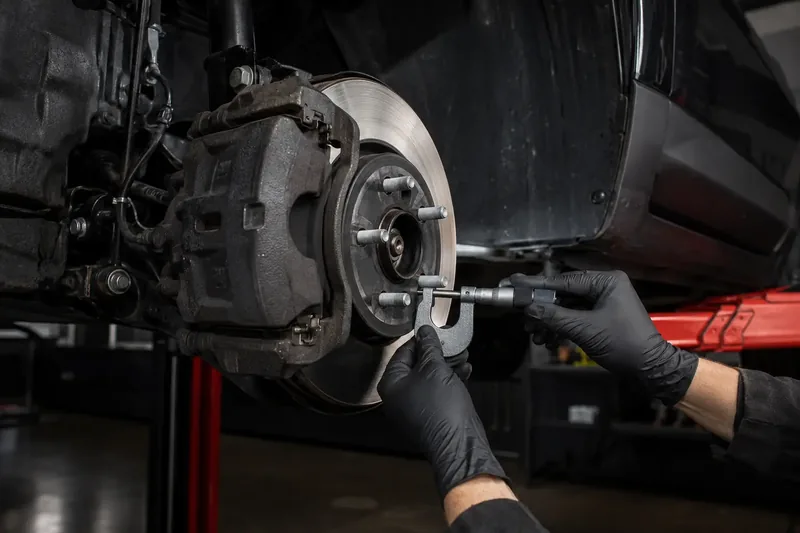
Brake discs can show surface oxidation after exposure to moisture. That observation alone does not establish the need for replacement. More substantial deterioration, unusual wear or a braking complaint requires a closer assessment of the working surfaces and relevant measurements.
The inner face of a disc may not look the same as the outer face visible through the wheel. This is one reason a quick look from outside the vehicle cannot answer every question about brake condition. A proper assessment considers both sides where access allows.
If the vehicle has vibration when braking, rust should not become an automatic explanation. Disc condition, thickness variation, mounting surfaces and other possible contributors need to be evaluated against the symptom. The repair should address the confirmed cause.
Steel brake lines deserve careful inspection
External corrosion can weaken steel brake lines. Areas where moisture or debris collects, including around supports, can be particularly important to inspect. The technician should assess visible condition and any signs of leakage rather than assuming that a line is sound because the brakes currently operate.
A soft or sinking pedal, fluid loss or a significant change in braking response needs prompt attention. Do not continue driving a vehicle with suspected hydraulic brake failure. Arrange assessment and recovery rather than attempting to prove that the vehicle can complete another trip.
Corrosion treatment is not a repair for weakened hydraulic tubing. Once a line is judged unserviceable, the repair needs suitable materials, routing and connections, followed by the appropriate system checks.
Suspension concerns are not all caused by rust
Suspension noise, wandering and uneven tire wear can have several causes. Corrosion may affect an assembly or its fasteners, but wear, impact damage and deteriorated rubber components also need consideration. The diagnostic question is how the condition relates to the reported symptom.
An inspection should examine the relevant joints, bushings, mounting points and structures using methods appropriate to the vehicle. A rusty surface does not prove a joint is loose. Equally, a component can have an operational problem without looking heavily corroded.
Where structural deterioration is suspected, its extent needs to be assessed before a routine alignment or parts replacement is treated as the complete solution.
Corroded fasteners can change the repair process
A repair that is straightforward on a clean vehicle may involve additional work when bolts, adjusters or mounting surfaces have deteriorated. Fasteners may resist removal, and alignment adjusters may not move as intended. Access and safe removal can become part of the job.
That does not mean every Ontario vehicle should receive the same extra charge. The estimate should explain the condition encountered and the work it creates. If the need for additional work becomes clear only after disassembly, the shop should explain it before proceeding beyond the authorization.
Knowing that an adjuster is seized before an alignment also helps set realistic expectations. Measuring the angles and correcting them are different tasks when the adjustment hardware cannot move.
Prevention and monitoring work together
Underbody cleaning, carried out appropriately for the vehicle, can help remove accumulated contamination. Follow the vehicle manufacturer's care guidance and avoid treating a wash as proof that hidden corrosion has been prevented. Areas that retain moisture still require inspection over time.
Any corrosion-protection product must be compatible with the application and kept away from components it could contaminate. Coating over an existing defect does not restore lost material or correct a sticking brake component.
A documented digital vehicle inspection can help you follow developing concerns. Ask which findings affect immediate operation, which need scheduled work and which can be monitored. That turns a general concern about road salt into a practical maintenance plan based on the vehicle's condition.
Common questions
Does every rusty part need replacement?
No. The assessment depends on material loss, operation, structural condition and the role of the component.