Puddle Under Your Parked Car? Record the Clues Before Choosing Repairs
A wet patch does not identify a failed part. Record its timing and location, recognize warning signs and establish the source before choosing repairs.
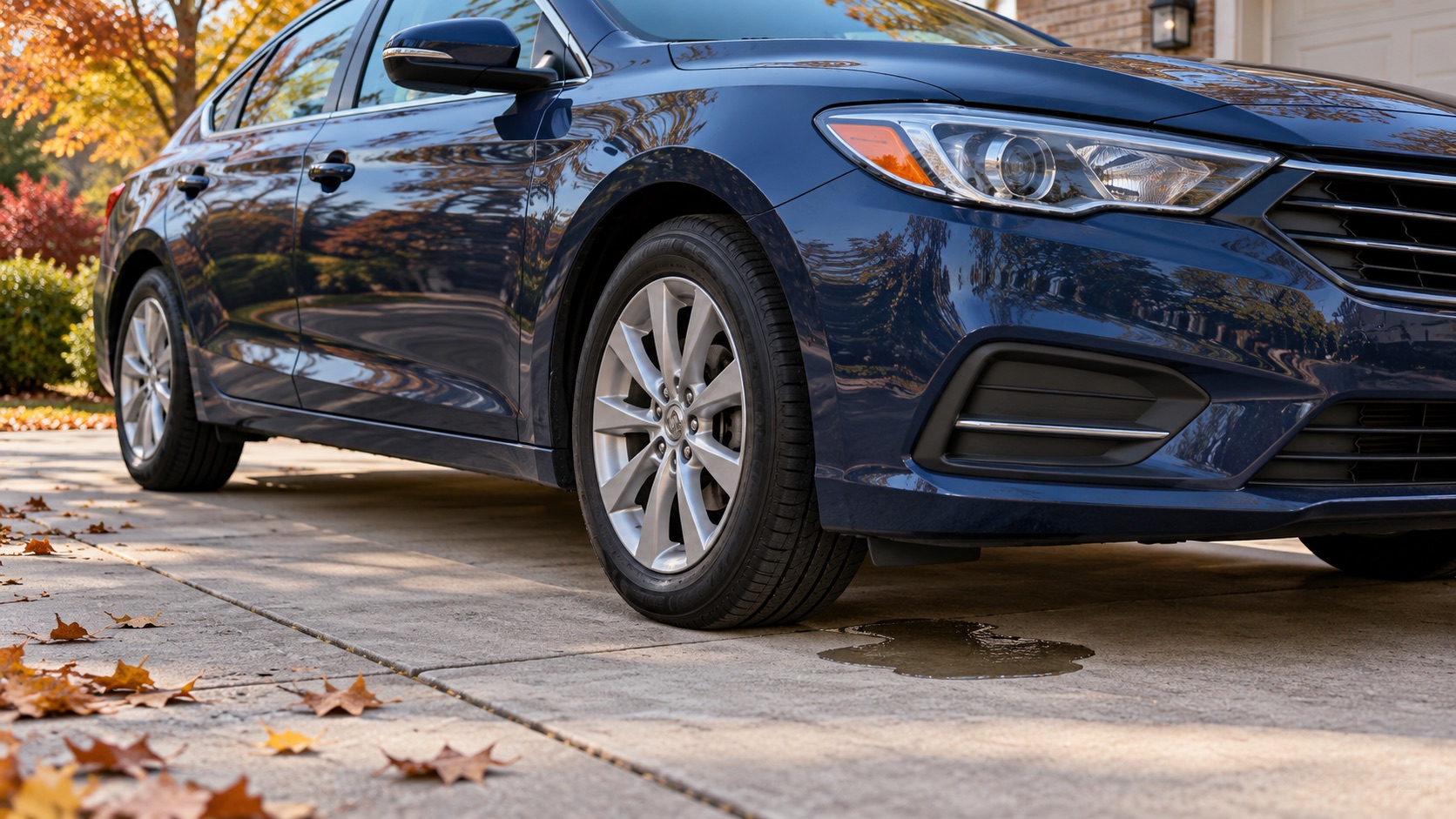
A puddle beneath a parked car is a clue, not a parts diagnosis. Before deciding that a hose, seal or pump needs replacing, establish whether the wet patch belongs to your vehicle, whether it is recurring and whether anything else has changed. A useful description can help an inspection begin in the right place.
For drivers in Bolton and Caledon, autumn rain can make that first observation less obvious. Wet pavement, water carried into a parking spot and normal air-conditioning drainage can complicate the picture. The goal is not to identify an unknown liquid by touching it. It is to notice what can be observed safely and arrange the appropriate assessment.
Decide whether the vehicle needs assistance
Do not treat every puddle as permission to continue driving. A suspected fuel leak, smoke, overheating, a brake warning or changed braking behaviour needs prompt attention. Stop somewhere safe and seek assistance rather than driving to see whether the problem gets worse. If fuel leakage is suspected, avoid restarting the vehicle and keep ignition sources away.
Follow the warning instructions in the owner's manual for your exact vehicle. Tell the person arranging assistance about both the puddle and any warnings or symptoms. The size of the visible patch alone cannot establish whether the vehicle is safe: a small mark does not rule out a significant problem elsewhere.
Keep children and pets away from unknown fluid. Do not taste it, deliberately smell it closely or put a hand into it. Do not crawl beneath a vehicle or lift it just to investigate a fresh patch. An inspection can be performed with appropriate equipment.
Record the parking conditions
From a safe standing position, photograph the patch and a wider view showing its position relative to the car. Note whether the ground was dry before parking, approximately how long the vehicle stood there and whether the surface slopes. A photograph with a fixed reference, such as a paving joint, is more useful than an unsupported estimate of the amount lost.
Describe the location in relation to the vehicle: front or rear, driver or passenger side, near a wheel or nearer the centre. Be consistent about which side you mean. The place a drip reaches the pavement does not necessarily identify where it began, so offer the location as an observation rather than a conclusion.
If you know the spot was already wet before you arrived, say so. If you do not know, leave that point uncertain. It is better to report a possible leak accurately than to build a repair decision around a patch left by another vehicle.
Recognize normal air-conditioning drainage
Ford explains that air conditioning removes moisture from the cabin air and drains the resulting water through a tube beneath the vehicle. A small puddle after using the system can therefore be normal. Its guidance describes drainage around the front passenger-footwell area, although the relevant location depends on the vehicle.
Record whether climate control or windscreen demisting was in use. A wet patch associated with those operating conditions is useful context, but appearance alone is not proof that an unknown liquid is harmless water. A recurring patch accompanied by a warning, a falling fluid level or other symptoms still deserves assessment.
If the carpet inside is wet as well, report that separately. Do not assume an exterior puddle and interior dampness share a cause, and do not probe drains with tools based on a generic online diagram.
Give the shop a timeline
A short timeline is often more useful than a long list of suspected parts. Explain when you first noticed the patch, whether it appeared after a journey or after the car sat overnight, and whether the same thing happened on another dry parking surface during ordinary use.
Include recent servicing, repairs, a road impact or an unusual warning. If the car was recently worked on, tell the shop what was done and when. That information gives context; it does not prove the previous work caused the concern.
Avoid repeatedly running the engine or taking extra trips simply to produce a better photograph. If a warning or safety concern is present, arranging assistance takes priority over collecting more evidence. Report what you already know and let the inspection establish the rest.
Use fluid-level information carefully
If you have existing records of fluid levels or previous top-ups, bring them. Only check a level yourself when the owner's manual provides a procedure you can follow safely. Some checks require particular conditions, and some systems are not intended for a straightforward owner check. Never open a hot pressurized cooling system.
Do not add a product merely because its colour resembles the puddle. Fluid requirements are vehicle-specific, and topping up does not explain why a level changed. Avoid stop-leak additives or improvised mixtures as a substitute for finding the source. If a warning requires you to stop, a top-up should not be treated as automatic clearance to drive.
Ask what evidence identifies the source
The AA's leak guidance emphasizes the value of location, appearance and recurrence, while advising professional help for persistent or uncertain leaks. Those observations help frame the inspection; they do not replace it.
Ask the shop what was found and how it connects to the reported patch. A useful explanation distinguishes the source of the leak from areas that became wet afterward. If a repair is recommended, ask which finding supports it and whether any further checks are needed before choosing parts.
After service, keep the inspection notes and ask how the original concern was checked. If another patch appears, report the conditions again rather than assuming the same fault has returned. Review our service information or contact Albion Auto Service with the vehicle details, photographs and any warning messages.
Featured image: AI-generated illustration of a generic parked car and a damp patch. It is not an Albion Auto shop or customer photograph and does not identify a particular leaking fluid or diagnosed fault.
Common questions
Does a puddle always mean a fluid leak?
No. Air-conditioning drainage and water already on the pavement can create wet patches. Other symptoms and a proper inspection help establish the cause.
Can I identify the fluid by colour alone?
No. Treat appearance as a clue and do not touch or taste unknown liquid. Report the location and circumstances to the shop.
Should I keep driving to see if the leak gets worse?
No. Do not create extra driving tests. Follow vehicle warning instructions and arrange assistance for suspected fuel leakage, overheating or braking concerns.