Does Your Tire Look Backwards? Check OUTSIDE and Rotation Markings
An OUTSIDE label and a rotation arrow give different instructions. Check the tire model and markings before assuming you need replacement tires.
After a seasonal tire change, you might notice that the tread on one side of the car looks different from the other. Or you might spot the word “OUTSIDE” on a sidewall and wonder whether it belongs on a particular corner. Those are sensible questions to raise before assuming the tires are wrong or ordering replacements.
For drivers in Bolton and Caledon, the useful starting point is the tire's actual markings and model. Tread appearance alone can be misleading. Directional and asymmetric describe different design features, and their fitting instructions are not interchangeable.
What an OUTSIDE marking tells you
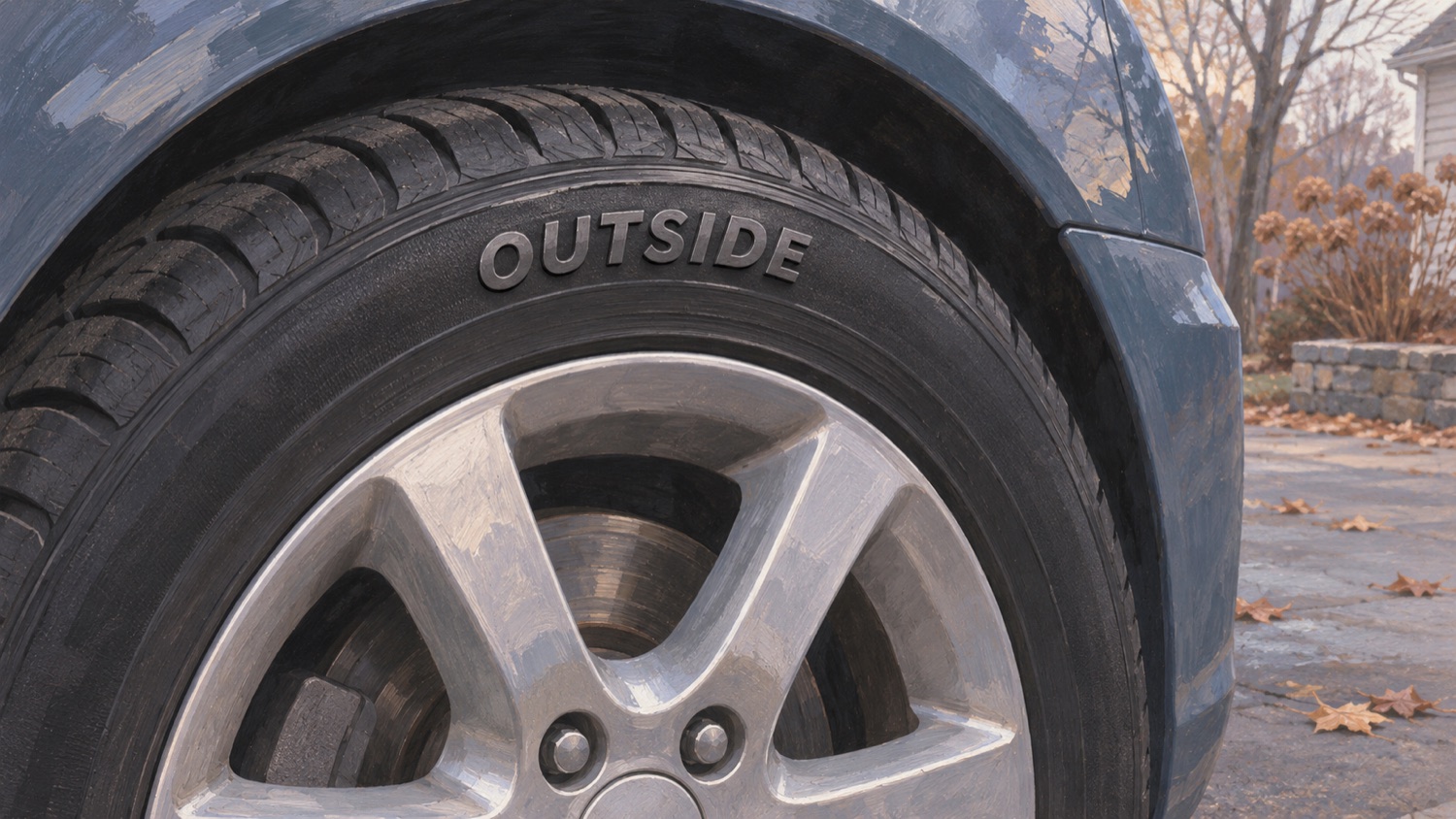
An asymmetric tread has different features across its width. Its sidewall marking identifies which face belongs toward the outside of the vehicle. Continental's mounting guidance specifies that the face marked OUTSIDE must face outward.
That word is not a passenger-side label. It does not, by itself, mean that the tire belongs exclusively on the left or right of the vehicle. Avoid judging the installation simply by whether the visible grooves appear to lean the same way on both sides.
If you can clearly see INSIDE on an outward-facing sidewall, contact the installer and ask them to check the mounting. Take a photo of the actual word and the tire model. This is much more useful than sending only a picture of the tread with “looks backwards” as the description.
What a rotation arrow tells you
A directional tire has a specified rolling direction. Michelin's technical FAQs explain that the sidewall arrow must match the tire's forward rotation when mounted on the vehicle.
The arrow follows the circumference; it is not simply an arrow pointing toward a destination in a photograph. Its position around the wheel matters when interpreting it. Continental explains that, when viewed on the upper half of the tire, the indicated direction should be toward the front of the vehicle. If that is hard to visualize, let the installer check it rather than guessing.
Look for the manufacturer's direction marking, not a shape in the tread that happens to resemble an arrow. Photograph enough of the wheel and vehicle to show which corner you are discussing. A tightly cropped arrow without context may not answer the question.
Some tires have both requirements
Do not assume that finding one marking means you can ignore another. Michelin notes that designs combining asymmetric and directional tread requirements need tires specific to the left and right sides. Ask the shop to confirm the exact model's instructions if both types of marking appear.
That is also why advice based on a friend's tires may not apply to yours. Two sets can look broadly similar while having different fitting requirements. Use the brand, full model name and sidewall information to identify what is actually installed.
There is no need to memorize every tread style. Your task is to point out the concern clearly; the service provider should establish the appropriate fitment.
Make the question easy to investigate
Before contacting the shop, gather a few details while the vehicle is safely parked:
- The vehicle's year, make and model.
- The tire brand and model visible on the sidewall.
- The corner involved, described from the driver's seated position.
- A photo showing the marking and a wider photo showing its location.
- The date of the tire change and whether you noticed any driving symptoms.
Do not crawl under the car or lift it just to photograph an inward-facing marking. Tell the shop what you can see safely and leave the rest to the inspection.
A useful message could be: “After the seasonal change, I can see INSIDE on the left rear tire's outer sidewall. Could you check its mounting?” That supplies an observation without deciding in advance whether the remedy is repositioning an assembly, remounting a tire or something else.
If the concern is only the way the tread looks, say that too. A visual question and a new vibration are different complaints, even if they arise after the same appointment.
Keep symptoms separate from the markings
Report new pulling, vibration, noise or pressure warnings on their own terms. Do not assume that a marking you have just noticed explains everything. Record when a symptom started and whether it occurs at a particular speed or during braking, but do not deliberately reproduce an unsafe condition.
Likewise, a car that feels normal does not establish that every tire is mounted correctly. The marking check and the symptom diagnosis answer different questions. Both can be addressed during the same inspection without turning one into a shortcut for the other.
If the vehicle feels unstable or has a severe new vibration, stop somewhere safe and seek advice about inspection or recovery. Do not continue a trip just to see whether the behaviour settles down.
Ask for the finding before approving new tires
An orientation concern does not automatically establish that a tire must be discarded. Ask the shop to identify the fitting error, if any, and assess the tire's condition before discussing replacement. Equally, do not assume that correcting orientation resolves any unrelated wear or damage already present.
A clear explanation should distinguish the mounting issue from the tire's suitability and condition. If replacement is recommended, ask what specific finding supports it. If a correction is made, ask the shop to confirm the final markings and positions rather than relying on appearance alone.
For your next seasonal appointment, bring the previous service record and mention any unresolved concerns before the work begins. You can review Albion Auto Service's tire services or contact the shop with the tire details and photos. Checking the instructions first can prevent an unnecessary parts purchase and keep the conversation focused on the actual issue.
Featured artwork is an AI-generated illustration with a simplified sidewall marking, not a photograph of a customer's tire or a complete tire-identification guide.
Common questions
Does OUTSIDE mean the tire belongs on the passenger side?
No. It identifies the face that should point outward. Check any additional directional instructions for the exact tire model.
Can tread appearance alone show whether a tire is fitted correctly?
No. Use the sidewall markings and manufacturer’s instructions, and ask the installer if the orientation is unclear.
Does an orientation mistake always require a new tire?
Not automatically. Have the fitting and tire condition assessed, and ask what evidence supports any replacement recommendation.